
Film study sheet · 3 of 11
Crash
Cultural concept: Prejudice, stereotypes & diversity
Paul Haggis · 2004 · thirty-six hours in Los Angeles: strangers collide, and every prejudice is tested. Oscar for Best Picture.
Open the full film study Official trailer
Created by Madame Carole Paoli Pompougnac · https://trame-lycee.netlify.app/films/crash.html
Film credits
| Title | Crash (USA / Germany, 2004) |
|---|---|
| Director | Paul Haggis |
| Screenplay | Paul Haggis and Bobby Moresco; story by Paul Haggis |
| Cast | Don Cheadle (Det. Graham Waters), Sandra Bullock (Jean Cabot), Brendan Fraser (D.A. Rick Cabot), Matt Dillon (Sgt. John Ryan), Ryan Phillippe (Officer Tom Hansen), Terrence Howard (Cameron Thayer), Thandiwe Newton (Christine Thayer), Chris “Ludacris” Bridges (Anthony), Larenz Tate (Peter), Michael Peña (Daniel Ruiz), Shaun Toub (Farhad), Bahar Soomekh (Dorri), Jennifer Esposito (Ria) |
| Cinematography | J. Michael Muro |
| Editing | Hughes Winborne (Oscar) |
| Music | Mark Isham; song “In the Deep” by Kathleen “Bird” York and Michael Becker (Oscar nomination) |
| Distributor | Lions Gate Films (USA) |
| Running time | 112 minutes |
| Release | premiere at Toronto, 10 September 2004 · USA, 6 May 2005 |
| Rating | R, language, sexual content and some violence |
| Awards | 78th Academy Awards (5 March 2006): 6 nominations, 3 Oscars, Best Picture, Original Screenplay, Film Editing |
Film language, with examples from the official trailer
Timecodes are approximate (± 2 s). Pause the trailer and check each example yourself.
Shots
| Word | Meaning |
|---|---|
| establishing shot / extreme long shot | shows the place; people look tiny |
| long shot | a whole body in its setting |
| medium shot | from the waist up |
| close-up | a face fills the frame: emotion |
| extreme close-up | a detail: eyes, a hand, an object |
| two-shot | two characters in one frame: a relationship |
| over-the-shoulder shot | we watch one character through another’s position |
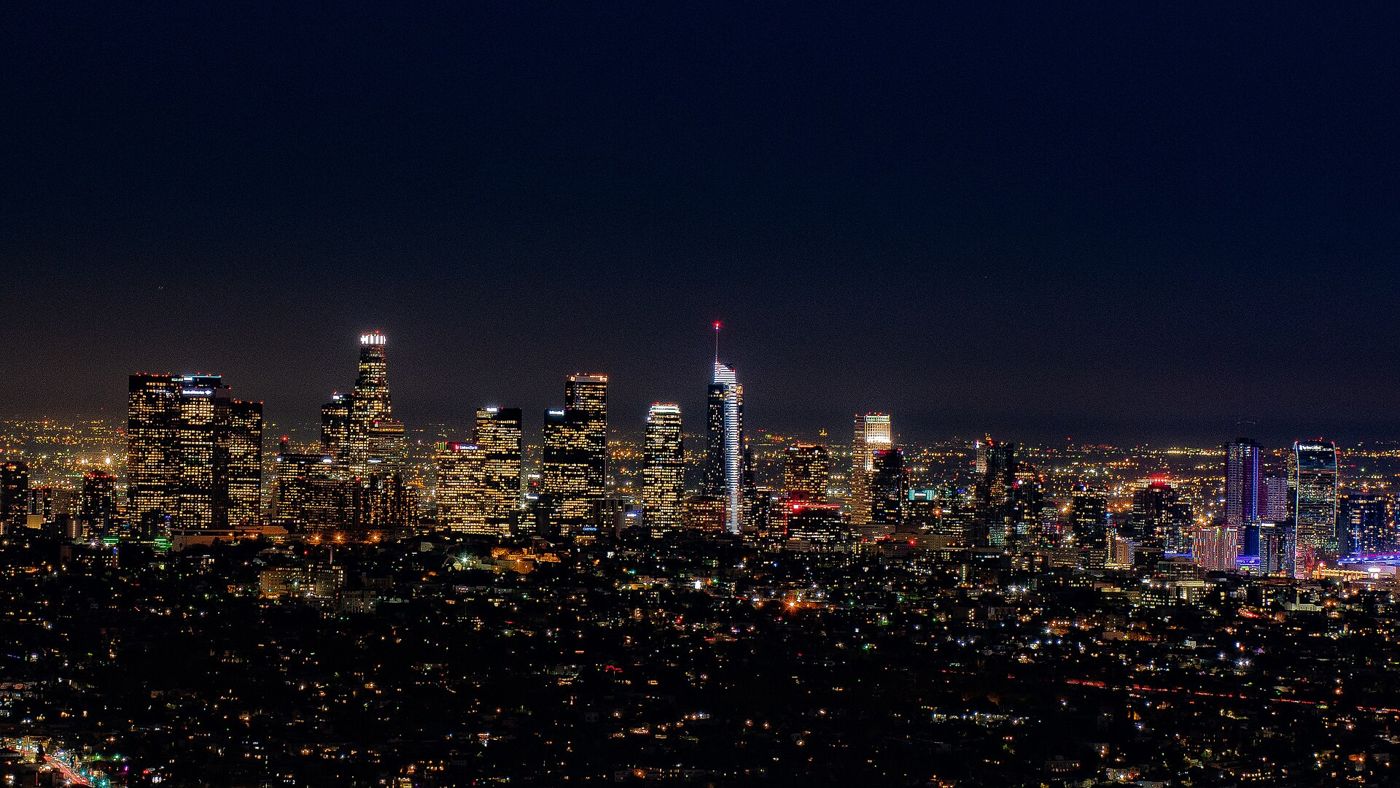
- 0:00aerial establishing shot of Los Angeles at night, over the voice-over “It’s the sense of touch…”
- 0:38extreme close-up on a hand: a gesture becomes a threat or a help
- 1:46close-up on a young police officer’s frightened face
- 1:58medium close-up on a woman in a kitchen: her anger is inside
Angles
| Word | Meaning |
|---|---|
| eye level | neutral, we are equal with the character |
| high angle | camera above: the character looks small or weak |
| low angle | camera below: the character looks powerful |
| canted (Dutch) angle | tilted frame: unease, a world out of balance |
| bird’s-eye view | straight down from above |
- 0:06high angle over the city: people disappear in the lights
- 1:22street scene at eye level: two men face each other
Camera movement
| Word | Meaning |
|---|---|
| pan | the camera turns horizontally |
| tilt | the camera moves up or down |
| tracking shot | the camera travels with a character or a car |
| zoom | the lens brings us closer |
| handheld camera | shaky, urgent, documentary feel |
| crane / aerial shot | the camera flies above the scene |
- 0:00slow aerial movement above the city
- 1:10handheld camera during a police stop: urgency, confusion
Lighting & colour
| Word | Meaning |
|---|---|
| high-key lighting | bright, few shadows: optimism |
| low-key lighting | dark, strong shadows: tension, mystery |
| backlighting | light behind a character: a halo or a silhouette |
| natural light | sun, windows, candles |
| colour palette | the dominant colours of the film |
- 0:42red and blue police lights on a face: danger, authority
- 1:34shallow focus: the city lights become blurred circles (bokeh) behind a character, isolation
- 1:58cold daylight in a kitchen: a “perfect” home that feels empty
Sound
| Word | Meaning |
|---|---|
| diegetic sound | the characters can hear it (a radio, a piano on stage) |
| non-diegetic sound | only the audience hears it (the score, a narrator) |
| voice-over | a voice we hear over the images |
| score | music composed for the film |
| silence | no sound: a shock, a pause |
| sound bridge | a sound that continues into the next scene |
- 0:00voice-over by Graham (Don Cheadle) over the images, it returns at the end: a sound frame
- 0:27a line said in a calm voice: “I am angry all the time, and I don’t know why.”
- whole trailera slow, melancholic piano and electronic score (non-diegetic) against sirens and city noise (diegetic)
Editing
| Word | Meaning |
|---|---|
| cut | a direct change of shot |
| cross-cutting | alternating between two places or stories |
| montage | a fast series of shots that compresses time |
| fade to black | the image disappears: an ending, a pause |
| intertitle | text on screen between images |
| slow motion | time slows down: importance, emotion |
- 0:18 · 0:34 · 0:50 · 1:02intertitles on black: “we are searching for an answer” / “we are moving forward” / “we are coming together” / “we are falling apart”
- whole trailercross-cutting between many characters who have not met yet
- 2:10title card: the word “crash” appears in broken light
Step into the period
Daily life
- Los Angeles in the early 2000s: long drives on freeways, SUVs, car stereos, flip phones
- A city of many communities: Black, white, Latino, Korean, Iranian (Persian), Armenian…
- Fear and suspicion after the attacks of 11 September 2001
Music
- Mark Isham’s ambient score: piano, synthesizers, voices
- Hip-hop on the car radio: a debate between Anthony and Peter in the film
- “In the Deep” by Bird York, Oscar-nominated song
Fashion
- Business suits for the D.A. and the detective; uniforms for the police
- Hoodies and leather jackets; the 2000s “casual” look
Places
- Downtown LA, the freeways, Brentwood (wealthy west side), Koreatown, a Persian-owned shop, a crime scene off a highway
- Inside cars: private bubbles in public space
Historical landmarks
- 1965 August: the Watts uprising in Los Angeles after a traffic stop. Immigration and Nationality Act: new immigration from Asia and Latin America transforms the city.
- 1991 3 March: Rodney King is beaten by LAPD officers; the scene is filmed by a witness.
- 1992 29 April: the officers are acquitted; several days of riots follow in Los Angeles.
- 2001 11 September: terrorist attacks; Middle Eastern Americans face suspicion (in the film, Farhad’s shop is attacked).
- 2004 10 September: Crash premieres at the Toronto International Film Festival.
- 2005 6 May: release in US cinemas.
- 2006 5 March: Crash wins Best Picture against Brokeback Mountain, Capote, Good Night, and Good Luck. and Munich.
- 2015 Ten years later, Paul Haggis says he would not have voted for his own film.
Sources: Academy of Motion Picture Arts and Sciences · Lionsgate, official page · Variety, 2015
Sentence starters for your sheet
- The aerial shot of the city suggests…
- The intertitles build a contrast between… and…
- Los Angeles in 2004 is a city where…
To close: a place, then exchange
Where is each character’s place at the start and at the end? Then: political · emotional · general interest · human rights, then go deeper: what passes between the characters, and who do they become?
From the place they find or lose, the deepest exchange in this film is…