
Film study sheet · 1 of 11
Hidden Figures
Cultural concept: Segregation & civil rights
Theodore Melfi · 2016 · three Black women mathematicians at NASA Langley and the race to put John Glenn into orbit.
Open the full film study Official trailer
Created by Madame Carole Paoli Pompougnac · https://trame-lycee.netlify.app/films/hidden-figures.html
Film credits
| Title | Hidden Figures (USA, 2016) |
|---|---|
| Director | Theodore Melfi |
| Screenplay | Allison Schroeder and Theodore Melfi, based on the book by Margot Lee Shetterly |
| Cast | Taraji P. Henson (Katherine G. Johnson), Octavia Spencer (Dorothy Vaughan), Janelle Monáe (Mary Jackson), Kevin Costner (Al Harrison), Kirsten Dunst (Vivian Mitchell), Jim Parsons (Paul Stafford), Mahershala Ali (Jim Johnson), Glen Powell (John Glenn) |
| Cinematography | Mandy Walker |
| Editing | Peter Teschner |
| Music | Hans Zimmer, Pharrell Williams, Benjamin Wallfisch |
| Distributor | 20th Century Fox |
| Running time | 127 minutes |
| Release (USA) | 6 January 2017 (wide) |
| Rating | PG, thematic elements and some language |
| Awards | 3 Oscar nominations (89th Academy Awards, 2017): Best Picture, Supporting Actress (Octavia Spencer), Adapted Screenplay |
Film language, with examples from the official trailer
Timecodes are approximate (± 2 s). Pause the trailer and check each example yourself.
Shots
| Word | Meaning |
|---|---|
| establishing shot / extreme long shot | shows the place; people look tiny |
| long shot | a whole body in its setting |
| medium shot | from the waist up |
| close-up | a face fills the frame: emotion |
| extreme close-up | a detail: eyes, a hand, an object |
| two-shot | two characters in one frame: a relationship |
| over-the-shoulder shot | we watch one character through another’s position |
- 0:26tracking two-shot through the windscreen: the three women in their car, escorted by a police car
- 0:50long shot: Katherine on a ladder in front of a giant blackboard, she looks small, the equations look huge
- 1:26close-up on Katherine’s face and glasses: concentration
- 1:02group shot: the West Area computers cheer together
Angles
| Word | Meaning |
|---|---|
| eye level | neutral, we are equal with the character |
| high angle | camera above: the character looks small or weak |
| low angle | camera below: the character looks powerful |
| canted (Dutch) angle | tilted frame: unease, a world out of balance |
| bird’s-eye view | straight down from above |
- 0:14the police officer is filmed slightly from below: authority
- 1:50eye-level shot of the NASA managers around a table: who has the power in the room?
Camera movement
| Word | Meaning |
|---|---|
| pan | the camera turns horizontally |
| tilt | the camera moves up or down |
| tracking shot | the camera travels with a character or a car |
| zoom | the lens brings us closer |
| handheld camera | shaky, urgent, documentary feel |
| crane / aerial shot | the camera flies above the scene |
- 0:26tracking shot: the camera moves with the car on the road
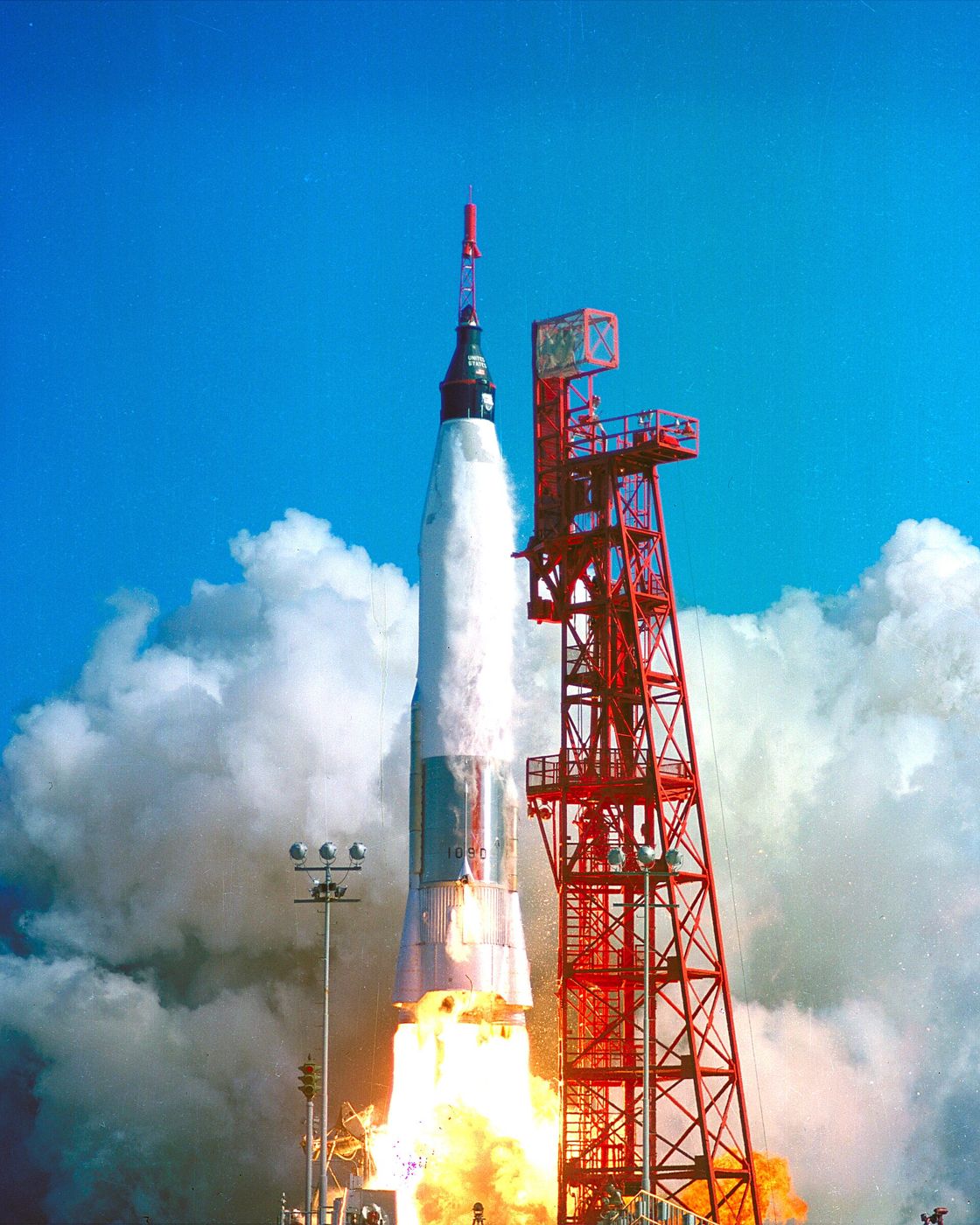
- 1:58the camera follows the rocket as it rises
Lighting & colour
| Word | Meaning |
|---|---|
| high-key lighting | bright, few shadows: optimism |
| low-key lighting | dark, strong shadows: tension, mystery |
| backlighting | light behind a character: a halo or a silhouette |
| natural light | sun, windows, candles |
| colour palette | the dominant colours of the film |
- 0:06bright natural light and pastel colours (turquoise car, 1960s dresses): high-key optimism
- 0:42dark background for the Sputnik satellite: the threat of the Soviet Union
Sound
| Word | Meaning |
|---|---|
| diegetic sound | the characters can hear it (a radio, a piano on stage) |
| non-diegetic sound | only the audience hears it (the score, a narrator) |
| voice-over | a voice we hear over the images |
| score | music composed for the film |
| silence | no sound: a shock, a pause |
| sound bridge | a sound that continues into the next scene |
- 0:30music with a strong beat starts under the dialogue (non-diegetic score)
- 1:58the roar of the rocket at lift-off (diegetic sound)
Editing
| Word | Meaning |
|---|---|
| cut | a direct change of shot |
| cross-cutting | alternating between two places or stories |
| montage | a fast series of shots that compresses time |
| fade to black | the image disappears: an ending, a pause |
| intertitle | text on screen between images |
| slow motion | time slows down: importance, emotion |
- 1:34intertitle on black: “Based on the untold true story”
- 2:06intertitles: “Three women” / “would change history”
- 1:58fast montage before the title: lift-off, faces, control room
Step into the period
Daily life
- Segregation laws in Virginia: separate schools, buses, bathrooms, coffee pots
- Women in skirts, gloves and hats; men in white shirts and ties at NASA
- Mechanical calculators, chalkboards and the first IBM electronic computers
Music
- Soul and gospel, the sound of Black churches and radios in the early 1960s
- The film’s songs are written by Pharrell Williams in a 1960s soul style
Fashion
- Fitted dresses with belts, cat-eye glasses, short curled hair
- Pencil skirts and cardigans in the office
Places
- NASA Langley Research Center, Hampton, Virginia
- Cape Canaveral, Florida, the launch site
- The West Area Computing office: a segregated unit
Historical landmarks
- 1896 Plessy v. Ferguson: the Supreme Court accepts “separate but equal”.
- 1941 Executive Order 8802 bans racial discrimination in the defense industry.
- 1943 Dorothy Vaughan joins the Langley laboratory (NACA).
- 1949 Dorothy Vaughan becomes head of West Area Computing, NACA’s first Black supervisor.
- 1951 Mary Jackson joins West Area Computing.
- 1953 Katherine Johnson starts at Langley.
- 1954 Brown v. Board of Education: segregation in public schools is unconstitutional.
- 1957 4 October: the Soviet Union launches Sputnik 1.
- 1958 NASA is created; segregated facilities at Langley are abolished; Mary Jackson becomes NASA’s first Black female engineer.
- 1961 12 April: Yuri Gagarin orbits Earth. 5 May: Alan Shepard, first American in space.
- 1962 20 February: John Glenn orbits Earth three times in Friendship 7.
- 1964 Civil Rights Act: discrimination in public places becomes illegal.
- 1969 Apollo 11: humans walk on the Moon.
- 2015 Katherine Johnson receives the Presidential Medal of Freedom.
- 2016 Margot Lee Shetterly publishes Hidden Figures; the film is released.
Sources: NASA, Katherine Johnson · NASA, Dorothy Vaughan · NASA, Mary W. Jackson
Sentence starters for your sheet
- This shot shows… / The camera is placed…
- The music makes me feel… because…
- In 1962, people in Virginia…
To close: a place, then exchange
Where is each character’s place at the start and at the end? Then: political · emotional · general interest · human rights, then go deeper: what passes between the characters, and who do they become?
From the place they find or lose, the deepest exchange in this film is…