
Film study sheet · 2 of 11
Green Book
Cultural concept: Segregation & civil rights
Peter Farrelly · 2018 · 1962: a Black classical pianist and his Italian-American driver tour the segregated Deep South.
Open the full film study Official trailer
Created by Madame Carole Paoli Pompougnac · https://trame-lycee.netlify.app/films/green-book.html
Film credits
| Title | Green Book (USA, 2018) |
|---|---|
| Director | Peter Farrelly |
| Screenplay | Nick Vallelonga, Brian Hayes Currie, Peter Farrelly |
| Cast | Viggo Mortensen (Tony “Lip” Vallelonga), Mahershala Ali (Dr. Don Shirley), Linda Cardellini (Dolores Vallelonga), Dimiter D. Marinov (Oleg), Mike Hatton (George) |
| Cinematography | Sean Porter |
| Editing | Patrick J. Don Vito |
| Music | Kris Bowers |
| Distributor | Universal Pictures |
| Running time | 130 minutes |
| Release | Toronto, 11 September 2018 · USA, 16 November 2018 |
| Rating | PG-13, thematic content, language including racial epithets, smoking, some violence and suggestive material |
| Awards | 91st Academy Awards (2019): 5 nominations, 3 Oscars, Best Picture, Supporting Actor (Mahershala Ali), Original Screenplay |
Film language, with examples from the official trailer
Timecodes are approximate (± 2 s). Pause the trailer and check each example yourself.
Shots
| Word | Meaning |
|---|---|
| establishing shot / extreme long shot | shows the place; people look tiny |
| long shot | a whole body in its setting |
| medium shot | from the waist up |
| close-up | a face fills the frame: emotion |
| extreme close-up | a detail: eyes, a hand, an object |
| two-shot | two characters in one frame: a relationship |
| over-the-shoulder shot | we watch one character through another’s position |
- ≈0:02establishing shot of a 1960s street: we enter the period
- ≈0:34profile shot of Don Shirley in the back seat: distance between the two men
- ≈2:14spotlit piano on stage: the artist alone
Angles
| Word | Meaning |
|---|---|
| eye level | neutral, we are equal with the character |
| high angle | camera above: the character looks small or weak |
| low angle | camera below: the character looks powerful |
| canted (Dutch) angle | tilted frame: unease, a world out of balance |
| bird’s-eye view | straight down from above |
- ≈0:14Shirley on a throne-like chair, slightly from below: dignity and status
Camera movement
| Word | Meaning |
|---|---|
| pan | the camera turns horizontally |
| tilt | the camera moves up or down |
| tracking shot | the camera travels with a character or a car |
| zoom | the lens brings us closer |
| handheld camera | shaky, urgent, documentary feel |
| crane / aerial shot | the camera flies above the scene |
- ≈2:26the camera follows the car on an empty road: the road movie
Lighting & colour
| Word | Meaning |
|---|---|
| high-key lighting | bright, few shadows: optimism |
| low-key lighting | dark, strong shadows: tension, mystery |
| backlighting | light behind a character: a halo or a silhouette |
| natural light | sun, windows, candles |
| colour palette | the dominant colours of the film |
- whole trailerturquoise car, green fields, warm skin tones: a nostalgic, colourful look
- ≈2:14a single spotlight on the piano
Sound
| Word | Meaning |
|---|---|
| diegetic sound | the characters can hear it (a radio, a piano on stage) |
| non-diegetic sound | only the audience hears it (the score, a narrator) |
| voice-over | a voice we hear over the images |
| score | music composed for the film |
| silence | no sound: a shock, a pause |
| sound bridge | a sound that continues into the next scene |
- whole trailerpiano music by Kris Bowers, diegetic in concert scenes, non-diegetic elsewhere
- ≈1:10“You never win with violence.”, a key line in Shirley’s calm voice
Editing
| Word | Meaning |
|---|---|
| cut | a direct change of shot |
| cross-cutting | alternating between two places or stories |
| montage | a fast series of shots that compresses time |
| fade to black | the image disappears: an ending, a pause |
| intertitle | text on screen between images |
| slow motion | time slows down: importance, emotion |
- whole traileralternation between comedy (the car) and tension (the South)
- ≈2:30end card “Inspired by a true friendship”
Step into the period
Daily life
- Jim Crow laws in the South: separate restaurants, hotels, toilets, entrances
- “Sundown towns” where Black people were not allowed after dark
- Long drives on two-lane highways before the Interstate network was finished
Music
- Classical piano, jazz and pop; Shirley’s trio (piano, cello, bass)
- Rock ’n’ roll and soul on the car radio (Little Richard, Aretha Franklin)
Fashion
- Tailored suits and ties; Shirley’s elegant clothes vs Tony’s casual shirts
Places
- The Bronx and Carnegie Hall, New York
- The Midwest, then the Deep South: Kentucky, North Carolina, Alabama…
Historical landmarks
- 1896 Plessy v. Ferguson accepts “separate but equal”.
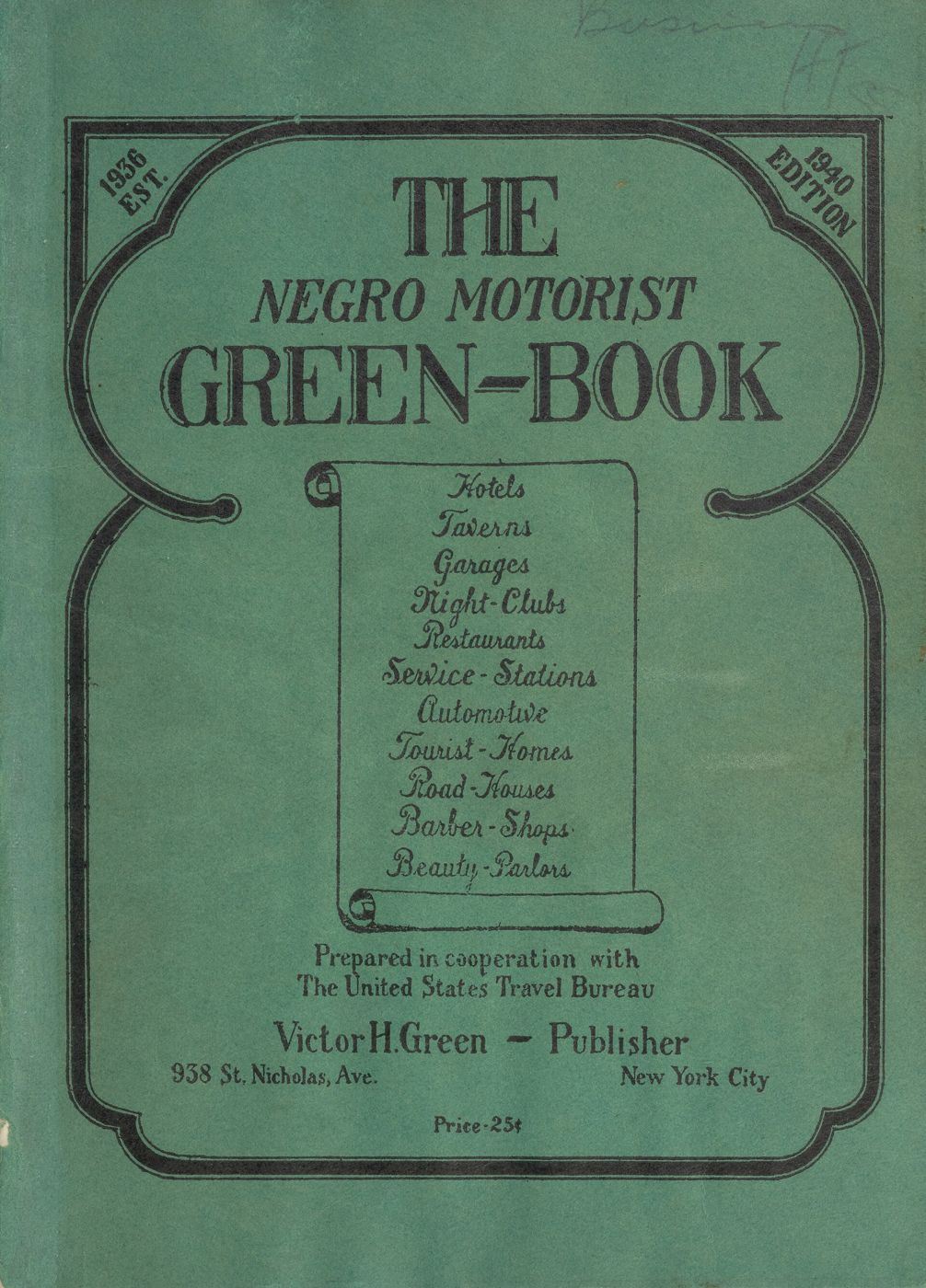
- 1936 Victor H. Green publishes the first Green Book, for New York.
- 1937 The guide becomes national.
- 1954 Brown v. Board of Education.
- 1955 Rosa Parks and the Montgomery bus boycott.
- 1956 Nat King Cole is attacked on stage in Birmingham, Alabama.
- 1961 Freedom Riders challenge segregated interstate buses.
- 1962 Don Shirley’s tour of the South, the film’s story.
- 1964 Civil Rights Act: segregation in public places becomes illegal.
- 1965 Voting Rights Act.
- c.1966 to 67 Last editions of the Green Book.
- 2018 Green Book is released; Shirley’s family criticises it.
- 2019 The film wins Best Picture.
Sources: NYPL, The Green Book (digital collection) · PolitiFact, How true is Green Book?
Sentence starters for your sheet
- The road movie format allows…
- The piano scene suggests…
- In 1962, a Black traveller in the South…
To close: a place, then exchange
Where is each character’s place at the start and at the end? Then: political · emotional · general interest · human rights, then go deeper: what passes between the characters, and who do they become?
From the place they find or lose, the deepest exchange in this film is…