
Film study sheet · 8 of 11
Shakespeare in Love
Cultural concept: Elizabethan theatre
John Madden · 1998 · London, 1593: a young playwright with writer’s block, a woman who dreams of the stage, and the birth of Romeo and Juliet.
Open the full film study Official trailer
Created by Madame Carole Paoli Pompougnac · https://trame-lycee.netlify.app/films/shakespeare-in-love.html
Film credits
| Title | Shakespeare in Love (USA / UK, 1998) |
|---|---|
| Director | John Madden |
| Screenplay | Marc Norman and Tom Stoppard |
| Cast | Joseph Fiennes (Will Shakespeare), Gwyneth Paltrow (Viola de Lesseps), Geoffrey Rush (Philip Henslowe), Colin Firth (Lord Wessex), Ben Affleck (Ned Alleyn), Judi Dench (Queen Elizabeth I), Simon Callow (Edmund Tilney, Master of the Revels), Tom Wilkinson (Hugh Fennyman), Imelda Staunton (the Nurse) |
| Cinematography | Richard Greatrex |
| Editing | David Gamble |
| Music | Stephen Warbeck (Oscar) |
| Distributor | Miramax Films (USA), Universal (international) |
| Running time | 123 minutes |
| Release (USA) | 11 December 1998 |
| Rating | R, sexuality |
| Awards | 71st Academy Awards (1999): 13 nominations, 7 Oscars, Best Picture, Actress (Paltrow), Supporting Actress (Dench), Original Screenplay, Score, Art Direction, Costume Design |
Film language, with examples from the official trailer
Timecodes are approximate (± 2 s). Pause the trailer and check each example yourself.
Shots
| Word | Meaning |
|---|---|
| establishing shot / extreme long shot | shows the place; people look tiny |
| long shot | a whole body in its setting |
| medium shot | from the waist up |
| close-up | a face fills the frame: emotion |
| extreme close-up | a detail: eyes, a hand, an object |
| two-shot | two characters in one frame: a relationship |
| over-the-shoulder shot | we watch one character through another’s position |
- openingclose-up on a hand writing with a quill: the film is about writing
- stage sceneslong shots of the wooden theatre, the crowd standing in the pit
Angles
| Word | Meaning |
|---|---|
| eye level | neutral, we are equal with the character |
| high angle | camera above: the character looks small or weak |
| low angle | camera below: the character looks powerful |
| canted (Dutch) angle | tilted frame: unease, a world out of balance |
| bird’s-eye view | straight down from above |
- Queenthe Queen filmed from below on her throne: royal power
- balconyhigh and low angles between a balcony and the ground, like Romeo and Juliet
Camera movement
| Word | Meaning |
|---|---|
| pan | the camera turns horizontally |
| tilt | the camera moves up or down |
| tracking shot | the camera travels with a character or a car |
| zoom | the lens brings us closer |
| handheld camera | shaky, urgent, documentary feel |
| crane / aerial shot | the camera flies above the scene |
- rehearsalthe camera circles the actors on stage
- streetstracking shots through muddy, crowded London streets
Lighting & colour
| Word | Meaning |
|---|---|
| high-key lighting | bright, few shadows: optimism |
| low-key lighting | dark, strong shadows: tension, mystery |
| backlighting | light behind a character: a halo or a silhouette |
| natural light | sun, windows, candles |
| colour palette | the dominant colours of the film |
- interiorswarm candlelight, gold and red: a painting-like Elizabethan world
- nightblue night light for secret meetings
Sound
| Word | Meaning |
|---|---|
| diegetic sound | the characters can hear it (a radio, a piano on stage) |
| non-diegetic sound | only the audience hears it (the score, a narrator) |
| voice-over | a voice we hear over the images |
| score | music composed for the film |
| silence | no sound: a shock, a pause |
| sound bridge | a sound that continues into the next scene |
- scoreStephen Warbeck’s romantic orchestral score (non-diegetic)
- end“You kiss by the book.”, a line from the play heard in the trailer
Editing
| Word | Meaning |
|---|---|
| cut | a direct change of shot |
| cross-cutting | alternating between two places or stories |
| montage | a fast series of shots that compresses time |
| fade to black | the image disappears: an ending, a pause |
| intertitle | text on screen between images |
| slow motion | time slows down: importance, emotion |
- montageparallel editing between rehearsal and real love: life and art mirror each other
- ≈1:30handwritten title: the film becomes a page
Step into the period
Daily life
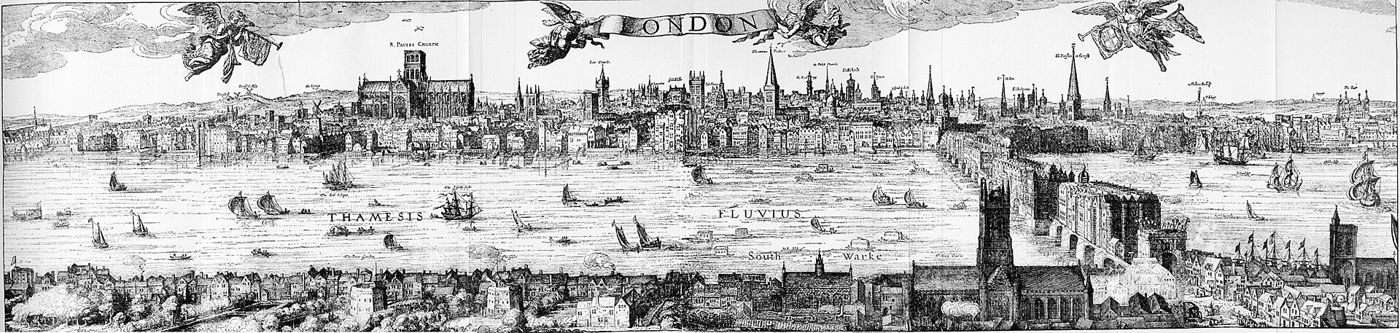
- London around 1593: about 200,000 people, the Thames as the main “road”
- Plague closes the theatres several times
- Theatres stand outside the City of London’s control, on the south bank and in the northern suburbs
Music
- Lute, viol and songs; music between scenes and at the end of plays
Fashion
- Ruffs, doublets and hose for men; corsets, farthingales and jewels for rich women
- Actors wear costumes often bought from rich people’s old clothes
Places
- The Rose theatre (Henslowe’s), the Curtain, later the Globe (1599)
- Whitehall Palace, where plays were performed for the Queen
Historical landmarks
- 1558 Elizabeth I becomes Queen.
- 1564 William Shakespeare is born in Stratford-upon-Avon.
- 1576 The Theatre, one of London’s first purpose-built playhouses, opens.
- 1587 Philip Henslowe builds the Rose theatre.
- 1588 The English defeat the Spanish Armada.
- 1593 Plague closes the London theatres; the film is set this year.
- c.1595 Shakespeare writes Romeo and Juliet.
- 1597 First printed edition (Quarto 1) of Romeo and Juliet.
- 1599 The Globe theatre opens.
- 1603 Death of Elizabeth I.
- 1616 Death of Shakespeare.
- 1660 8 December: the first recorded professional actress appears on an English stage, as Desdemona.
- 1997 The reconstructed Shakespeare’s Globe opens in London.
- 1999 Shakespeare in Love wins 7 Oscars.
Sources: Project Gutenberg, Romeo and Juliet · Folger Shakespeare Library · Shakespeare’s Globe
Sentence starters for your sheet
- The candlelight creates…
- This shot mirrors the play because…
- In 1593, a woman could not…
To close: a place, then exchange
Where is each character’s place at the start and at the end? Then: political · emotional · general interest · human rights, then go deeper: what passes between the characters, and who do they become?
From the place they find or lose, the deepest exchange in this film is…